

Does your breath shape actually matter?
Your breath is constantly telling your nervous system whether it’s safe or not.
In short, yes. Yes, a lot.
This is something I am weirdly obsessed with, and for good reason. For 29 years of my life, I could only breathe into my chest. My ribs and intercostals barely moved, my diaphragm felt permanently stuck, and I lived with constantly tight shoulders and a sore neck.
You might relate to this: a breath that feels restricted, permanently stuck in the chest or upper thoracic region, quietly keeping your nervous system and endocrine system (hormone glands) switched on.
Sorry to break it to you, but trying to breathe through your nose isn’t going to do very much long-term if your breath is stuck in your chest.
I’ve been there, and it doesn’t feel very nice. I’ve also found it incredibly difficult to make meaningful changes from this place. A state of dysregulation shuts down the more evolved parts of the brain we rely on for planning, reflection, and choosing our next move.
To be clear, there is nothing inherently wrong with breathing into your chest intermittently, for example during exercise. The issue arises when this pattern becomes sustained and habitual.
I also find it fascinating how sensitive breath shape is to environment. Whenever I’ve spent a prolonged period of time in a busy city, my breathing pattern noticeably shifts and becomes more chest-dominant. It usually takes a few days, and a change of environment, for the necessary muscles to begin moving freely again.
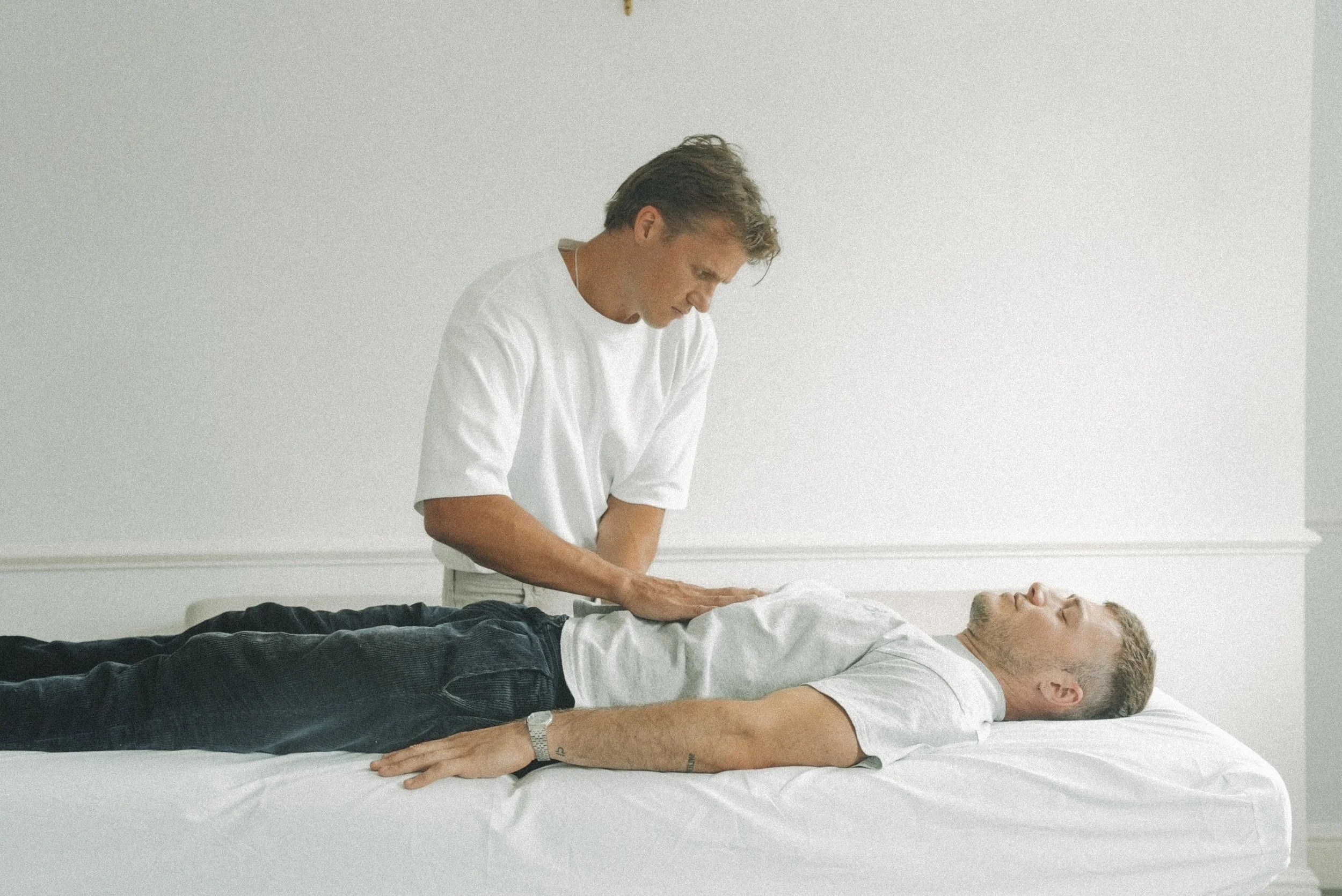
What “Breath Shape” Really Means
Breath shape describes how air and pressure move through the body, mostly outside conscious awareness. A healthy breath creates subtle, three-dimensional expansion through the diaphragm and ribcage, rather than lifting straight up into the chest and shoulders.
When breath becomes narrow and chest-dominant, the body recruits unnecessary muscles and often sends a stress signal to the nervous system. When breathing stays lower and the diaphragm functions properly, the nervous system receives the opposite message: it’s safe to relax.
Ideally, we have range in our breath shape — the ability to breathe low when calm and allow the breath to rise into the chest when effort or demand requires it.
A physiological sigh uses this range, which is why it so often leaves us feeling noticeably more relaxed.
How Chest-Dominant Breathing Becomes a Problem
The majority of my clients present with a shallow, chest-dominant breathing pattern. This is increasingly common, particularly in busy cities like London, where the nervous system is under near-constant stimulation.
Physiologically, this pattern is often paired with tight intercostal muscles, limited downward movement of the diaphragm on inhale, and excessive tension through the neck and shoulders. As a result, the upper trapezius and other accessory breathing muscles are forced to work far harder than they should.
Much of my work, then, involves freeing the neck and shoulders so the breath can return to a more efficient, lower pattern.
This places unnecessary pressure on the entire system, but especially on the nervous system, the system responsible for determining whether we feel safe or threatened. It is very difficult to feel genuinely relaxed while breathing predominantly into the chest. A chest-dominant breath keeps the body in a subtle but persistent state of vigilance.
As a result, the nervous system drives changes in the cardiovascular system, often increasing resting heart rate and blood pressure. Prolonged time spent in sympathetic activation also stimulates the adrenal glands via the HPA axis, leading to sustained release of adrenaline, cortisol, and noradrenaline. Over time, altered CO₂ tolerance and disrupted breathing chemistry further reinforce this stress response.
Put simply, habitual chest-dominant breathing can be a significant, and often overlooked, contributor to ongoing anxiety.
Another reason I find it completely mind-boggling is that so many people actively train their muscles, yet rarely consider retraining how they breathe.
When Chest Breathing Is Useful, and When It Isn’t
Chest breathing is not always bad. It can be extremely helpful during exercise or in any situation that requires a short burst of sympathetic activation, such as running to catch a train, reacting quickly, or dodging traffic.
It becomes problematic when you are lying on the sofa after a long day trying to relax, or when you are in a busy, crowded place doing your best to stay calm. In these moments, if your breathing speeds up, becomes shallow, and remains dominant in the chest, it simply adds fuel to the fire.
In these situations, slower, more spacious breathing, allowing movement through the ribs, abdomen, and pelvic region, gives the nervous system the signals it needs to feel more regulated and at ease.
What a Dynamic Breathing Shape Actually Does
A dynamic breathing shape is one in which the diaphragm, ribcage, and surrounding tissues all participate in the breath. On inhale, the diaphragm descends and the intercostal muscles allow the ribs to move and expand, distributing pressure through the torso rather than lifting into the neck and shoulders. On exhale, this system recoils naturally without force. The breath is adaptable and requires minimal effort.
When breathing functions this way, it directly influences how the body operates. Communication through the vagus nerve improves, supporting parasympathetic activity and the body’s ability to downshift out of stress. Oxygen utilisation becomes more efficient, not because more air is taken in, but because gas exchange is better supported at a cellular level.
A healthier breathing pattern also supports the balance between oxygen and carbon dioxide. As CO₂ tolerance improves, breathing naturally slows and deepens, reinforcing calm rather than urgency. This shift supports digestion as well, encouraging gut motility and the body’s rest-and-digest processes.
In short, when the breath has more space, the entire system functions with less effort.
How This Pattern Actually Changes
Breathing patterns are largely subconscious, which means they do not change through awareness alone. The same factors that shape breath in the first place, posture, environment, sustained stress, and long-standing protective or control-based patterns, continue to reinforce it unless something shifts at a physical and neurological level.
For change to occur, the body needs both capacity and repetition. Restrictions through the ribcage, diaphragm, neck, and shoulders often limit how the breath can move. These restrictions develop gradually and are reinforced thousands of times each day through habitual movement and breathing.
Shifting breath shape therefore follows a similar process to physical rehabilitation. The tissues involved in breathing need to regain movement, and the nervous system needs consistent exposure to a different breathing experience. Over time, with repetition, the body updates its default and it becomes ‘sticky.’
The aim is not to consciously control the breath, but to create enough safety and freedom to allow for more efficient breathing shape to emerge automatically.
In summary, it’s worth checking in with where your breath naturally tends to flow. If it habitually sits high in the chest, it may be contributing to unnecessary anxiety. With the right body-led support, this pattern can be shifted.
Thank you for reading,
Will
