

How Breathwork Changed the Way I Relate to Stress

Source: Will Twigden
For most of my life, I was quietly run by unconscious stress responses.
They lived below the surface, shaping my decisions before I even realised what was happening. Any time I moved toward something meaningful - a new idea, a relationship shift, a dream that felt right — my system reacted instantly with the message: this isn’t safe.
My body would either shoot upward into Hyperarousal, which felt like anxiety, urgency and overwhelm, or crash downward into Hypoarousal, the numb, frozen state where everything feels too heavy to face. This pattern was exhausting. I felt drained physically, mentally and emotionally, and I never understood why.
Everything changed the moment I learned about the Window of Tolerance
The Window of Tolerance, a concept introduced by Dr. Dan Siegel, describes the range in which our nervous system can function optimally. Inside this window, we feel regulated. We can think clearly, express our emotions without being overwhelmed and stay connected to ourselves and the world around us.
Life feels manageable here.
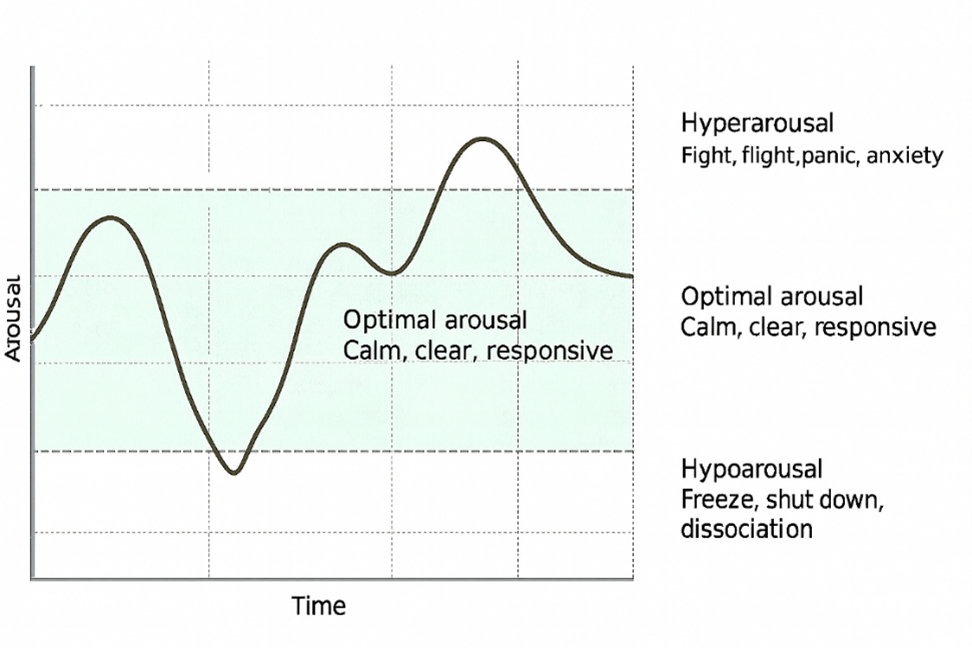
Source: Will Twigden
But when we fall outside this window, our body isn’t being dramatic or irrational - it’s relying on a survival system that evolved long before modern life (~500m years ago). It cannot distinguish real threat and danger, so it acts fast, and sometimes irrationally.
Everyone’s window is different. Upbringing, early experiences of safety, stress loads and even the demands of adult life all shape its size. This is why comparing your responses to someone else’s rarely helps - we’re not working with the same nervous system history.
One important idea from Somatic Therapy is that the window can expand over time. The process is called Pendulation, which means gently moving between activation and safety, outside the window and back inside. It is still considered emerging research, but it’s widely used in somatic work because it gives the nervous system a chance to build resilience gradually.
Hyperarousal: When You’re Above the Window
Hyperarousal feels like anxiety, anger, overwhelm or racing thoughts. The body shifts into fight or flight. Heart rate increases, breathing becomes shallow and the chest tightens. The thinking part of the brain - the prefrontal cortex - becomes less active as survival mode takes over.
Hypoarousal: When You’re Below the Window
Hypoarousal is the opposite. It feels like numbness, shutdown, fogginess or disconnection. The body moves into a freeze or collapse response. Energy drops, breath slows and awareness shrinks inward.
The way back from Hypoarousal is gentle stimulation: small movements, sensory input, soft light or sound, or the presence of a safe person. These signals slowly reawaken the system and bring life back into the body.
How Breathwork Changed My Stress Patterns
Breathwork became the tool that allowed me to meet my stress responses rather than be ruled by them. It helped me return to regulation, understand my patterns and eventually widen my window so I could move through life with more capacity.
1.Mind-based breathing brings you back into the window
Practices like box breathing or 4-7-8 breathing guide the nervous system back toward calm. A longer exhale activates the Vagus Nerve, supporting parasympathetic regulation. Even five minutes can shift your state noticeably.
I use these a lot when feeling anxious on flights and other busy places.

2. Connected breathing helps widen the window
Connected breathing - used in Facilitated Breath Repatterning (FBR) - is a rhythmic breath with no pauses between the inhale and exhale. This creates a controlled rise in activation that allows stored emotional material to surface. Because you stay aware and connected during the process, these emotions can be integrated rather than repressed.
I like to think of it as we are “dosing activation” into the client’s system with lots of presence and safety, and then we see how it responds - over time the brain and body learn that activation is not “danger” but we can tolerate it - this translates into a wider capacity in every day life.
Breathwork gave me a safe space to feel the emotions of stress rather than fear them. And the more I practised, the easier it became to access that regulated state in daily life.

Source: Will Twigden
Why Stress Feels So Heavy - and Why Breathwork Works
Much of the stress we carry isn’t conscious. It lives in the background: old experiences, suppressed desires, avoided conversations, years spent in fight, flight or freeze. Connected breathwork acts like a bridge between conscious and unconscious material, allowing these patterns to rise to the surface where they can be processed.
I often compare it to clearing a blocked gutter. Water can’t flow when the gutter is clogged. In the same way, we can’t expect to feel grounded, calm or capable when we’re carrying years of unprocessed emotional debris. A narrow window is not a personal failure - it’s the natural result of carrying too much for too long.
Breathwork helps clear the load.
A Note on Safety
Although breathwork is powerful, intensity isn’t always beneficial. Some approaches push people far outside their window too quickly, which can overwhelm the system. This can create more distress rather than healing.
My approach is rooted in safety, titration and gradual integration. I work with the pace of the body, not against it.
The Role of Touch and Bodywork
Touch, when offered safely and consensually, can support regulation by reducing cortisol and increasing oxytocin. It communicates safety directly to the body in a way words can’t. Gentle bodywork helps soften long-held tension and supports the integration of emotional material that surfaces during breathwork. It also supports healthier, more dynamic breathing patterns - which from my experience allow you to pendulate in and out of the window with more ease.

Source: Will Twigden
Titration and Pendulation
These principles, drawn from Somatic Experiencing, sit at the heart of breath repatterning:
Titration: working with small amounts of activation at a time.
Pendulation: gently moving between activation and safety.
Together, they help the nervous system expand sustainably rather than through force.
Final Thoughts
Breathwork has reshaped how I relate to stress, to my dreams and to myself. Understanding my nervous system and learning how to work with it rather than against it has given me a sense of choice I didn’t have before. I can pursue what’s meaningful without being held back by old fear responses.
My invitation is simple: begin noticing where you spend most of your time. Do you live above your window or below it? What helps you come back in? It might be a conversation, stillness, movement or breath - it will be unique to you.
Life changes the moment you start paying attention.
Thank you for reading,
Will
